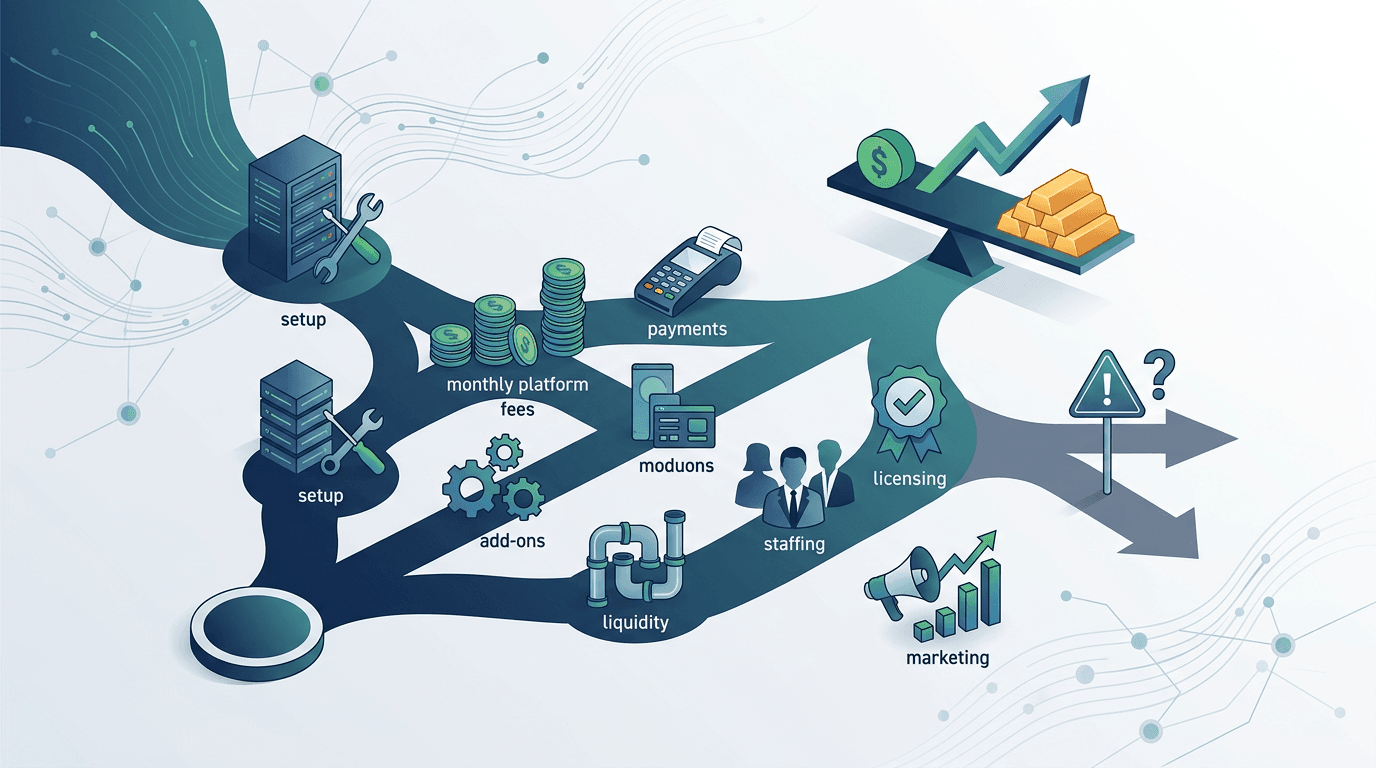
The MT5 white label cost for new brokers typically runs from $2,000 to $15,000 in one-time setup and $800 to $4,000 per month for the platform, using indicative 2025 ranges. The full first-year budget is far larger once licensing, liquidity, staff and marketing are added: about $97,000 for a lean launch and over $1 million for a fully regulated one.
Introduction
Most pricing pages list fees and stop. Few show what a broker spends in the first twelve months, and that total decides whether a launch survives. An MT5 white label is a ready-made MetaTrader 5 setup that a provider hosts and runs while you brand and sell it as your own. A server licence is the alternative: the broker licenses the platform directly and runs its own infrastructure.
Disclosure: mt5greylabel.io sells in this space, so the guide below stays neutral and includes honest pros and cons. Method: every figure is an indicative range as of 2025, built from typical vendor pricing structures rather than one quote, and each scenario states its assumptions. Your real prices will depend on the vendor and your region.
Is MT5 free or paid, and what is the MT5 white label cost for new brokers?
The MT5 app is free for traders. Brokers pay to run it. The bill has a one-time setup (branding, platform configuration, bridge connection, groups and instruments) and a monthly fee covering platform access, maintenance, hosting and support.
| Cost item | Indicative range (USD, 2025) | What drives the range |
|---|---|---|
| One-time setup | $2,000 to $15,000 | Template or custom branding, number of groups and instruments, bridge work |
| Monthly platform fee | $800 to $4,000 | Account caps, hosting, support hours, pricing model |
| Monthly add-ons | $300 to $3,000 | CRM, client portal, mobile apps, KYC, affiliate module |
| Liquidity, payments, data and risk tools | $500 to $10,000 per month | A-Book or B-Book, number of payment providers, volumes |
Three pricing models dominate. A flat fee charges the same amount every month. A revenue share takes a percentage of trading revenue. A per-lot fee charges for each lot traded. Rule of thumb: startups with unpredictable volume do better on a flat fee, because costs stay predictable. Growing brokers should recheck. On $20,000 of monthly revenue, a 15% share costs 20,000 × 0.15 = $3,000, while a $2,000 flat fee costs less.
Keep white label cost separate from launch cost. Licensing, staff and marketing never appear on the vendor invoice, yet they usually outweigh it.
What does a first-year budget really look like: lean, mid-tier or fully regulated?
The formula is simple: 12-month total = setup + one-off licensing and capital + (12 × monthly burn). All figures below are assumptions in USD.
- Lean: setup $5,000; licensing, legal and capital $20,000; monthly burn $6,000 (platform $1,500, add-ons $500, liquidity and payments $500, staff $1,500, marketing $2,000). Total: 5,000 + 20,000 + (12 × 6,000) = $97,000.
- Mid-tier: setup $10,000; licensing, legal and capital $80,000; monthly burn $20,000 (platform $3,000, add-ons $1,500, liquidity and payments $3,500, staff $7,000, marketing $5,000). Total: 10,000 + 80,000 + (12 × 20,000) = $330,000.
- Fully regulated: setup $15,000; licensing, legal and capital $350,000; monthly burn $60,000 (platform $4,000, add-ons $3,000, liquidity and payments $10,000, staff $28,000, marketing $15,000). Total: 15,000 + 350,000 + (12 × 60,000) = $1,085,000.
The lean case assumes a partner’s licence or a low-cost jurisdiction where that is lawful. The mid-tier case assumes a mid-cost licence, and the top case a strict jurisdiction with high minimum capital. Part of that capital is held rather than spent, but you still need the cash.
The trading model changes both cost and risk. An A-Book broker passes orders to a liquidity provider, earns markup or commission and carries little market risk, but pays bridge and liquidity fees. A B-Book broker takes the other side of client trades, saves those fees and needs a capital buffer for losses. A hybrid splits flow between the two.
Region matters. According to the FCA, UK retail CFD leverage is capped at 30:1 on major currency pairs, and a retail client cannot lose more than the money in their account. Those are UK rules, and other regions differ. Whether MT5 can be offered to clients in the USA depends on local rules and the broker’s licensing.
How much does it cost to start forex brokerage, and when does the budget pay back?
Year one costs roughly $97,000 to $1,085,000, per the scenarios above. Revenue comes from three places: spread markup, commission, and swap. The swap on MT5 is the overnight interest charged or credited for holding a position past rollover. The broker sets it from interest-rate differentials plus a markup, and the broker keeps that markup.
Here is a lean break-even model, with every input an assumption:
- Revenue per standard lot (markup plus commission): $6.
- Break-even volume: 6,000 monthly burn ÷ 6 = 1,000 lots per month.
- Each funded client trades 5 lots a month: 1,000 ÷ 5 = 200 funded clients.
- Cost per funded account: $150. A $2,000 monthly marketing budget buys 2,000 ÷ 150 ≈ 13 clients a month, so 200 clients takes about 15 months (200 ÷ 13.3), ignoring churn.
The upfront $25,000 (5,000 + 20,000) must still be recovered after that. A planning window of 12 to 24 months to profit is sensible, as an assumption rather than a statistic. Underfunded launches fail because cash runs out before client numbers catch up.
Which hidden costs and contract terms should you check before you sign?
Quotes often leave out payment processing and chargebacks, per-provider payment integration, bridge and liquidity provider fees, market data, risk software and hosting redundancy. A “free” or very cheap package usually recovers the money through high revenue share, mandatory add-ons or steep renewals.
Ask every vendor:
- What is the contract term, and are there minimum volumes?
- Do prices escalate at renewal?
- What are the exit and migration fees, and can you export client data?
- What uptime does the SLA guarantee, and what is the remedy?
- Are there caps on groups or accounts?
- What are the support hours?
White label is the wrong choice when you need deep platform customisation, expect high volume that makes a flat licence cheaper, or cannot accept the vendor’s control over uptime and upgrades. Then a server licence is worth pricing. White label wins on speed and low upfront cost, and loses on control.
Conclusion
Budget the whole launch, not just the platform fee. Copy the three scenarios into a sheet, replace each assumption with a real quote, and run the vendor checklist before signing. For the launch sequence itself, read our step-by-step guide to starting a forex brokerage with MT5 white label in 2025. mt5greylabel.io is one provider among several, so compare. Every figure here is indicative and dated 2025.
FAQ
Can I use MT5 in the USA?
Availability depends on local rules and on whether the broker holds the right licences. Traders should confirm a broker’s US registration before opening an account.
How much does forex cost?
Trading cost is the spread, any commission and swap. A 1.0 pip spread on a mini lot (about $1.00 per pip) costs 1.0 × $1.00 = $1.00 per trade.
What is the swap fee on MT5?
The swap fee is the overnight interest charged or credited when a position stays open past rollover. The broker sets the rate and keeps its markup.
Is MT5 free or paid?
The MT5 app is free for traders. Brokers pay setup and monthly fees to run it.
Key takeaways
- Indicative 2025 white label ranges: $2,000 to $15,000 setup, $800 to $4,000 monthly.
- First-year totals in the worked scenarios: $97,000 lean, $330,000 mid-tier, $1,085,000 fully regulated.
- Licensing, staff and marketing often outweigh the platform fee.
- The lean break-even example needs about 200 funded clients and roughly 15 months.
- Check term, escalators, exit fees, data export and SLA before signing.
Risk warning: Trading forex and CFDs carries a high risk of loss and may not be suitable for all investors. You should never trade with money you cannot afford to lose. Past performance is not a reliable indicator of future results. This article is for educational purposes only and does not constitute financial, investment, or trading advice. If you are unsure, seek advice from an independent, suitably qualified financial adviser.